What Is Checkerboard Mesa?
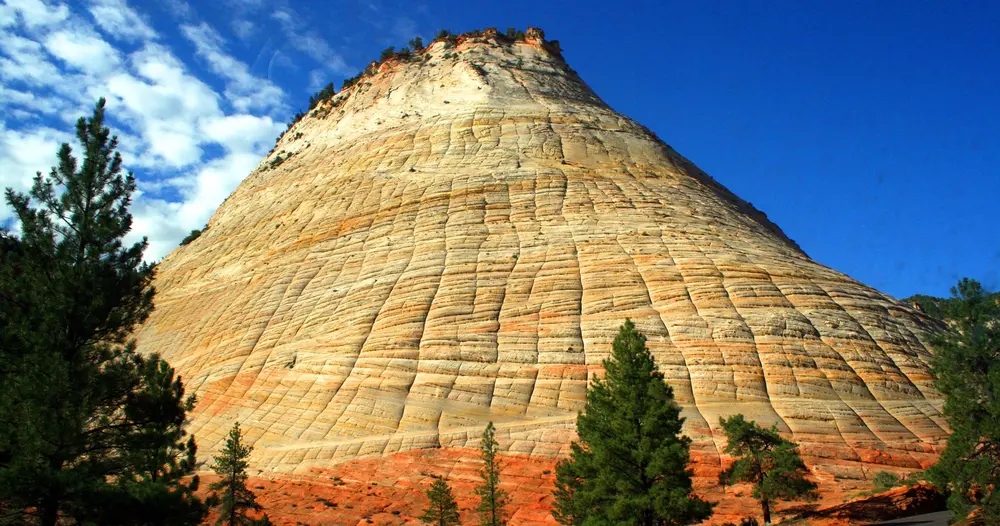
Checkerboard Mesa is one of the most visually striking formations in all of Zion National Park, a massive, rounded dome of pale cream sandstone whose surface is carved into a precise grid of horizontal and vertical lines. The effect is so geometric, so deliberate-looking, that first-time visitors often assume it was man-made. It wasn't. Every line is the work of natural forces acting over hundreds of millions of years.
The formation sits near Zion's East Entrance, visible directly from the Zion–Mt. Carmel Highway. Its scale is hard to grasp from a distance: the mesa face stretches hundreds of feet high, and those thin-looking lines are actually fractures and grooves that can be several feet wide up close.
The Geology Behind the Grid
The checkerboard pattern is the product of two entirely different geological forces working in perpendicular directions.
Horizontal lines are ancient bedding planes. When this rock formed around 180 million years ago during the Jurassic Period, this entire region was a vast Sahara-like desert. Massive sand dunes hundreds of feet tall slowly built up and were buried under new layers. As they compacted into rock over millions of years, the boundaries between successive dune layers became the horizontal banding you see today.
Vertical lines formed as the Colorado Plateau rose and the rock began to erode. Stress relief caused the sandstone to crack in regular, evenly-spaced vertical joints. Rain and freeze-thaw cycles then widened these joints into the distinctive furrows visible across the mesa's face.
Pro tip: Morning light from the east illuminates the mesa's face most dramatically, accentuating the depth and shadow of each groove. This is often one of the first stops on tours entering from the east.
Navajo Sandstone, The Canvas
Checkerboard Mesa is made entirely of Navajo Sandstone, one of the most iconic rock formations of the Colorado Plateau. This formation extends across parts of Utah, Arizona, Nevada, and Colorado and in some places reaches thicknesses of over 2,200 feet. In Zion, the Navajo Sandstone defines the park's towering white and cream cliffs.
The sandstone preserves the original cross-bedding of ancient sand dunes, slanted lines within the rock that show which way the prehistoric winds blew. If you look closely at Checkerboard Mesa, you can see these internal dune patterns cutting diagonally across the main grid.
What to Expect When You Visit
Checkerboard Mesa is best appreciated from the roadside pullout along the Zion–Mt. Carmel Highway, just inside the East Entrance. There's no trail required, the formation presents itself dramatically from ground level.
- Roadside viewpoint, no hiking required
- Best light in the morning hours when the sun hits the east-facing surface
- The grid pattern is visible from hundreds of feet away; binoculars reveal even more detail
- Marks the transition from Zion's lower canyon to the higher plateau, vegetation and temperature change noticeably here
- In winter, the pale cream sandstone against a snow-dusted landscape is particularly striking
Why This Place Stays With You
There are hundreds of rock formations in Zion, but Checkerboard Mesa has a quality that others don't: it stops conversations. Something about a perfect geometric grid appearing in wild nature triggers a deep cognitive dissonance. When the brain accepts that 180 million years of geology is the answer, the scale of deep time becomes suddenly, viscerally real.